


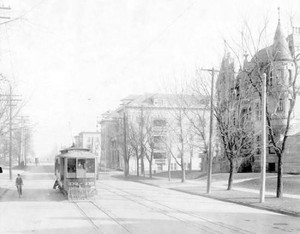
 Colfax is a tale of two avenues—east and west, that begins with the establishment of the city of Denver in 1850. The United States was still reeling from the Civil War. For many, heading west was a way to start over after a devastating war. During the silver boom, Colfax was the main artery from the east into mines located in the mountains.
The Golden Road of Denver
As miners filled the young streets of Denver, the main throughway to the west known as the Golden Road became, figuratively speaking, paved in silver. Shops, merchants and law firms lined what was then called Grand Avenue. East Grand Avenue quickly became the playground of the rich. Mansions popped up everywhere. This, in part, was enhanced in 1867 when the capital was moved from Golden to Denver. East Grand Avenue was the in-place to live.
Grand Avenue would soon be renamed Colfax Avenue in honor of the Senator Schuyler Colfax from Indiana who later became Speaker of the House of Representatives, and the Vice President of the United States under Ulysses S. Grant.
For West Colfax, the story was very different. While East Colfax became the home for the posh, West Colfax was anything but. Known as “No Man’s Land” and “Jim’s Town”, the west side of Colfax was desolate. The Ute Indians used the west route to access trade in the commercial hub of Denver and the miners used it to trek into the mountains to gain their riches.
But the timing wasn’t good. The 1870s would prove to be a very difficult time in the world. As the railroads expanded, many banks and investors railed their money into the iron buffalo. But the country as a whole had placed their eggs into one basket. What was known then as the Great Depression hit the world’s economy hard and in particular, it hit the US’s heavily invested market of the railroads. Banks were in debt, loans defaulted, and companies became worthless.
By the 1890s West Colfax was lined with modest homes for factory workers and laborers. With the influx of immigrants the nation began to work its way back from the great depression. As the East became the gem of the Queen City of the West, the west side became its home for her laborers. The west became, once again, filled with traffic as the flow of wagons and peddlers made their way to Denver from the agricultural communities of Morrison and Golden. Growth spurred both sides.
As traffic flooded the West, East Colfax became a tree-lined wonder for the rich as the city tried to make it, “the finest, grandest residential avenue between St. Louis and San Francisco.” East Colfax came to be known as Denver’s premier residential avenue.
Denver Neighborhoods Shaped by History
Then the Silver crash of 1893 would reshape both sides of Colfax in the way we recognize it today. Hit hard, the mansions and the construction boom of the east stymied. Mansions became abandoned, and quickly became dilapidated. As residents tried to cope with the devastation, they took on different roles. The commercial core of the city would arise in the East pushing the residential areas into Capitol Hill, Curtis Park, Highlands, each splintering off into different developments seeded during the great economic years.
As Colfax and the nation limped along, World War I, the Great Depression of the 1930s and soon after, World War II would play out and continue to define the now, well set and established neighborhoods of East and West Colfax.


 Like Us here on Facebook: